
SIXTEEN
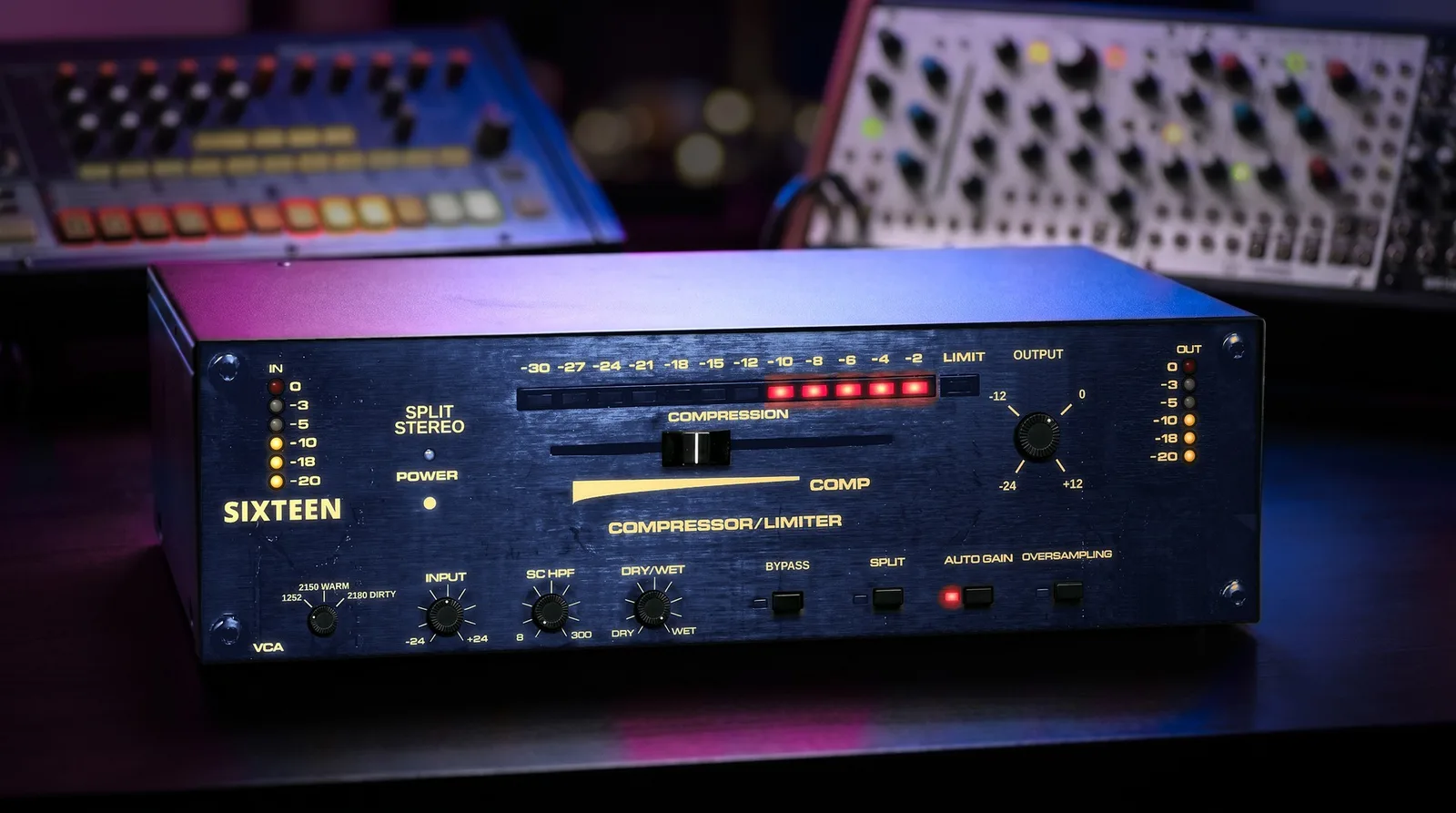
A one-slider compressor / limiter modelled on the 163X, built from measurements of a working unit. Plus what the hardware never had: three VCA voices, INPUT, OUTPUT, SC HPF, DRY / WET, SPLIT stereo, AUTO GAIN, OVERSAMPLING and a LIMITER.
AAX, AU, VST3 · 64-bit only · macOS and Windows
Sold and delivered through Audioloom
A one-knob classic in your DAW
A 1:1 emulation of the 163X compressor, built from measurements of a working unit.
The original unit was sold as “the one-knob squeezer”, and that was the whole idea: one control, and nothing else to set. Moving that single slider lowers the threshold and raises the output gain at the same time, so the level stays roughly where it was and all you hear is the amount of compression.
It was built for home and project studios, not for the big rooms. That is also why it ended up on so many records: it was the compressor anyone could afford and nobody had to learn.
SIXTEEN is modelled on the 163X. We measured a working unit and built the model from those measurements, not from the data sheet. Everything in the plugin that is not the single control is there to put the machine in the right place in a modern session. The machine itself is still a one-knob box.
Section by section
The one control
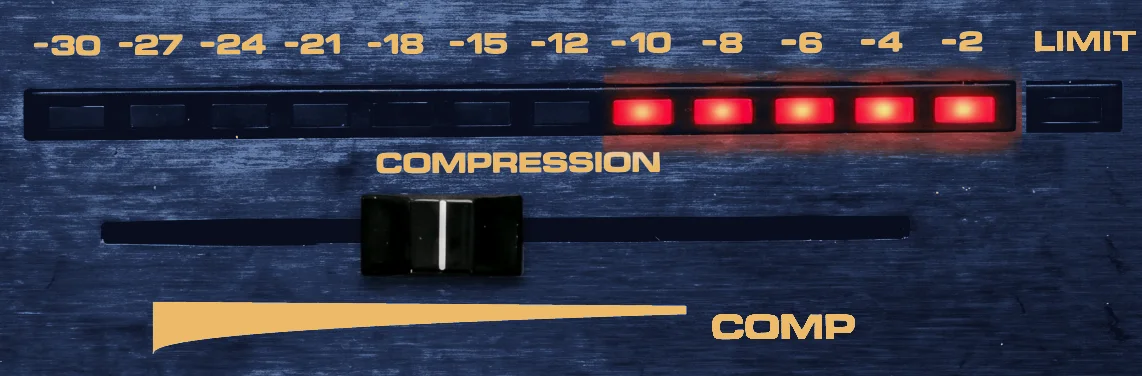
COMPRESSION lowers the threshold and raises the gain together.
COMPRESSION is the slider from the original unit. It lowers the threshold and raises the gain together, exactly as the hardware does.
There is no attack, no release and no ratio, because the machine has none. The sound you get depends on how hard you go in, which is why INPUT matters here more than on most compressors.
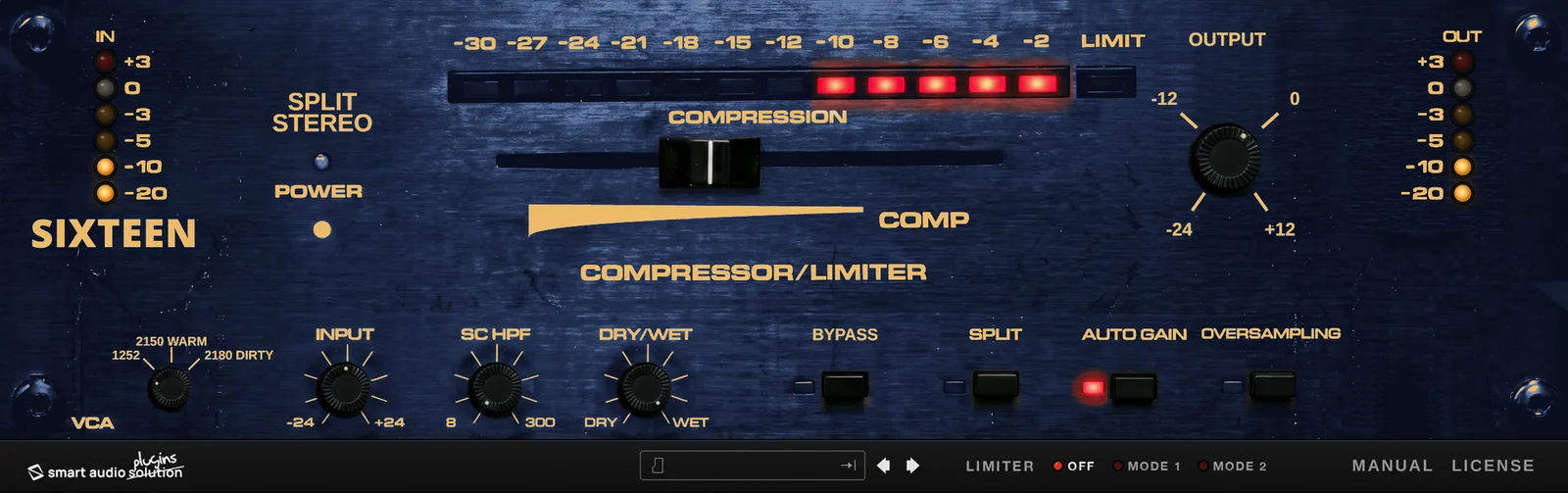
The LED row above the slider is the gain reduction meter, from −2 to −30 dB.
Like the hardware, SIXTEEN has real make-up gain: from +5.8 dB with the control at zero up to +21.7 dB at full travel, before any compression. Use OUTPUT to bring the level back down where you need it, or switch AUTO GAIN on.
VCA, INPUT, SC HPF and DRY / WET
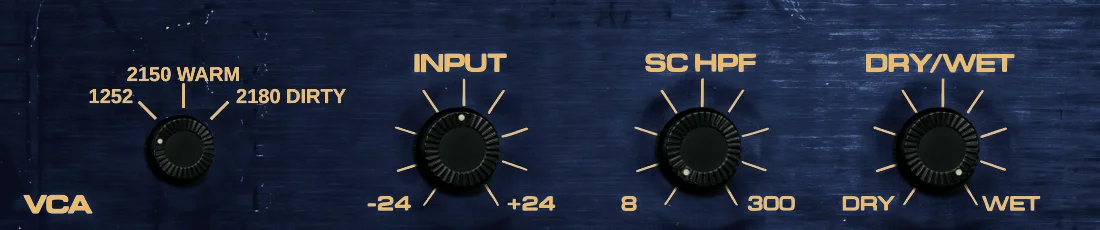
The four knobs under the slider.
VCA selects one of three voices. 1252 is the chip in the unit we measured, with nothing added. 2150 WARM lifts the second harmonic and gives a little more body. 2180 DIRTY adds second and third harmonic and is clearly coloured. This changes the harmonics only: the compression curve and the timing stay the same on all three.
INPUT (−24 to +24 dB) sets how hard the signal hits the detector and the VCA. On this machine it is the second half of the one control: same slider position, different input level, different sound. The IN meter on the left of the panel reads the level after this knob.
SC HPF (8 to 300 Hz) is a 6 dB per octave high-pass filter on the detector only. It never touches the sound you hear, just what the machine listens to. At 8 Hz you have the unit we measured. Open it up and the low end stops driving the compression.
DRY / WET (0 to 100 %) is a straight blend between the direct signal and the compressed one. Leave it at 100 unless you are after parallel compression.
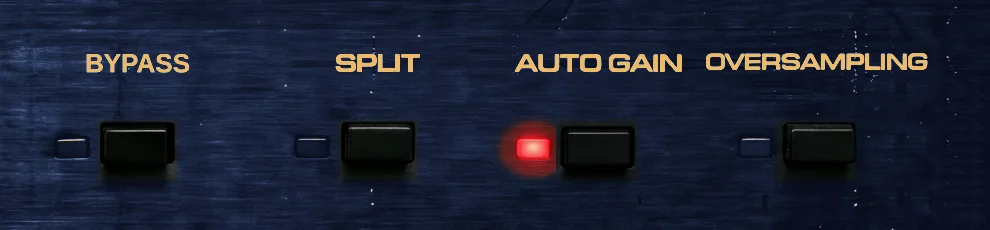
BYPASS, SPLIT, AUTO GAIN and OVERSAMPLING
Four keys, each with its own lamp.
BYPASS takes the machine out of the path, so you can hear the track as it was.
SPLIT: off, one detector reads both channels and gives them the same gain, the way two units strapped together would work. On, left and right compress on their own, and the SPLIT STEREO lamp at the top left of the panel is lit. You can switch it while the music plays.
AUTO GAIN compensates for the gain change after the compressor, in order to keep the same volume automatically.
OVERSAMPLING runs the output ceiling and the VCA harmonics at twice the sample rate. Worth switching on when you push the machine hard on bright material.
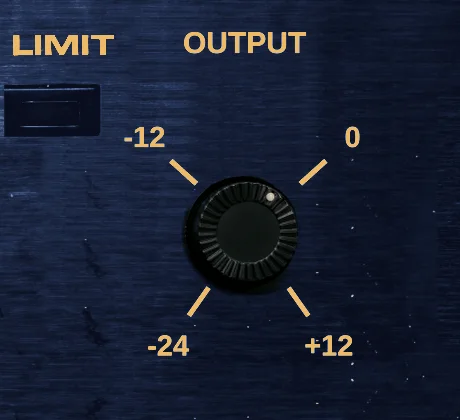
OUTPUT and LIMITER
The level of the compressed path, and a safety limiter after everything else.
OUTPUT (−24 to +12 dB) is the level of the compressed path only. This is where you give back, by hand, the make-up gain that the machine added. With AUTO GAIN on it is a trim on top of it. The OUT meter on the right of the panel reads the level leaving the plugin.
LIMITER, in the black bar under the panel, is a safety limiter on the output, after everything else. It has three positions, OFF, MODE 1 and MODE 2: click the one you want and its red lamp lights. In MODE 1 and MODE 2 no sample leaves the plugin above −0.1 dBFS. In OFF the output is not limited.
MODE 1 is the fast one. It looks a little ahead, 16 samples, about 0.3 ms at 48 kHz. MODE 2 is the gentle one: it turns down only the peaks that go over the ceiling.
Neither mode is a clipper. They turn the level down for a moment, they do not cut the shape of the wave. The LIMIT lamp, next to the COMPRESSION meter, is lit while the limiter is working. If it is lit often, bring OUTPUT down.
Three ways to use it
On a voice. AUTO GAIN on, COMPRESSION around 40, then compare bypass and engaged. If the voice comes out too even, take COMPRESSION down and push INPUT up instead: same amount of compression, more of the machine.
On a bass or a kick. SC HPF around 80 to 120 Hz, so the low end stops making the whole track move, then COMPRESSION to taste.
On a drum bus. SPLIT off, COMPRESSION low, DRY / WET around 50. Try 2180 DIRTY here before you try it anywhere else.
One rule for all three: match the level before you judge. Louder sounds better for about four seconds, and then it doesn’t.
Specifications
Technical data.
- Type — feed-forward compressor / limiter, soft knee, measured model
- Controls — eleven, one of which does the compressing
- Threshold — −11.5 to −50.5 dBFS, set by COMPRESSION
- Make-up gain — +5.8 to +21.7 dB, set by COMPRESSION
- Gain reduction meter — −2 to −30 dB
- Input — −24 to +24 dB
- Output — −24 to +12 dB
- Dry / wet — 0 to 100 %
- Detector filter (SC HPF) — 6 dB/octave high-pass, 8 to 300 Hz
- VCA — three voices, 1252 (measured) / 2150 WARM / 2180 DIRTY
- Channels — 2, linked or independent (SPLIT)
- AUTO GAIN — calculated from the controls
- Output ceiling — +8.1 dBFS
- Output limiter — OFF / MODE 1 / MODE 2, ceiling −0.1 dBFS
- Oversampling — 2x, switchable
- Input and output meters — 0 = 0 dBFS
- Latency — about 1 ms, reported to the host
DAW support
AAX, AU and VST3 — 64-bit only.
- Ableton Live 11+ — Mac & PC, AU / VST3
- Bitwig 4+ — Mac & PC, AU / VST3
- Cubase 13+ — Mac & PC, VST3
- Digital Performer 11+ — Mac & PC, AU / VST3
- FL Studio 23+ — Mac & PC, VST3
- GarageBand 10+ — AU
- Logic Pro 10+ — AU
- Pro Tools 12+ — Mac & PC, AAX
- Studio One 5+ / Fender Studio — Mac & PC, AU / VST3
- Reaper 6+ — Mac & PC, VST3
- Cakewalk Next by BandLab — PC, VST3
AAX is a trademark and software of Avid Technology. Audio Units is a trademark and software of Apple Inc. VST3 is a trademark and software of Steinberg Media Technologies GmbH. dbx is a trademark of its owner; SIXTEEN is not affiliated with or endorsed by it.
System requirements
- macOS 10.15 or higher — Intel and Apple Silicon native
- Windows 10
- RAM 4 GB minimum, 16 GB recommended
- Disk 200 MB free on the system drive
- Formats AAX, AU, VST3 — 64-bit only